 Job
Category
Jobs News & Market Trends
Jobs News & Market Trends guides on Job Guide Daily.
Des opportunités d’emploi avec une rémunération compétitive pourraient vous attendre au Canada
Le Canada recrute dans de nombreux secteurs, mais les conditions, les salaires et les règles d'emploi varient fortement selon la province, l'employeur et le type de contrat. Ce guide explique à quoi ressemble le travail au quotidien, qui embauche réellement, comment la rémunération est structurée et quelles vérifications faire avant de signer.
Marisol Andrade · 8 min read
Jobs in the USA provide employment opportunities across growing industries, with competitive salaries and benefits for workers at every career stage.
Work in the United States spans hospital floors, rooftop solar arrays and remote data teams, and openings are spread unevenly across industries and states. Total employment is projected to increase from 170.3 million to 176.2 million, growing 3.5 percent over the decade, slower than the 10.9 percent growth recorded 2015–25 (U.S. Bureau of Labor Statistics, 2026-08-27) — so the sector you target matters.
Priya Nathwani · 8 min read

Jobs in the USA offer career opportunities across numerous fields, with competitive wages and benefits for workers of all skill levels.
The United States hires across almost every field — healthcare, logistics, retail, trades, manufacturing, tech, administration and public service — at entry level as well as for experienced and licensed workers. Pay and benefits vary enormously by state, industry, employer size and whether the job is hourly, salaried or contract.
Theo Lindqvist · 9 min read

Jobs in the USA offer opportunities across dozens of industries, with competitive salaries and benefits for workers at every experience level.
The US job market hires across healthcare, logistics, retail, government, skilled trades, tech and customer support, usually at entry, mid and senior levels at the same time. What you earn depends less on the industry than on how the job is structured — hourly or salaried, employee or contractor, exempt or non-exempt from overtime — and on the state and city you work in.
Desmond Okafor · 9 min read
Jobs in the USA provide opportunities across multiple sectors, with attractive pay and benefits for both beginners and experienced workers.
US hiring runs across healthcare, logistics, retail, hospitality, skilled trades, administration, customer support, construction and technology, and many of those employers run entry-level and experienced tracks side by side. What the work involves, how you are paid and which benefits attach depend on the sector, the employer and the state far more than on any national rule.
Marisol Andrade · 8 min read
Explora tu próxima oportunidad profesional y descubre empleos en sectores populares y diferentes puestos
Explorar tu próxima oportunidad profesional significa elegir entre sectores que contratan de forma constante —atención al cliente, salud, logística, retail, administración y soporte técnico— y entender qué pide cada puesto antes de postular. Esta guía explica cómo es el trabajo día a día en US, qué tipos de empleadores contratan, cómo suele estructurarse el pago y qué verificar antes de decir que sí.
Marisol Andrade · 8 min read

Explore Your Next Career Opportunity and Discover Jobs Across Popular Industries and Different Roles
This guide is for anyone in the United States who knows they want a different job but has not settled on the role, the industry, or the first application. It walks you through how to compare occupations using free federal career tools, how pay is usually structured once an offer arrives, and how to check an employer before you hand over anything.
Priya Nathwani · 9 min read

10 Recession-Proof Career Paths Backed by Data
No job is immune to a downturn, but some fields keep hiring because the demand behind them — illness, aging, care, infrastructure, software that has to keep running — does not pause. In the US, healthcare support, healthcare practitioner and technical, and community and social service occupations are projected to be among the five fastest-growing occupational groups in the 2025–35 decade (U.S. Bureau of Labor Statistics, 2026), and wind turbine service technicians and solar photovoltaic installers were projected as the two fastest-growing of all 832 occupations for 2023–33 (U.S. Bureau of Labor Statistics, Monthly Labor Review, 2024).
Olu Adeyemi · 9 min read
Top Companies Hiring This Month (Updated Weekly)
A "top companies hiring this month" list is a snapshot of which US employers currently have the most open roles and the fastest-moving pipelines — it shifts week to week, which is why it is refreshed rather than written once. This guide covers what those actively-hiring roles usually involve, which kinds of employer do most of the hiring, how pay is normally structured, and what to verify before you accept anything.
Sofia Bauer · 8 min read

4-Day Workweek Countries and Companies Adopting It
A four-day week usually means one of two things: the same full-time hours compressed into four longer days, or fewer hours for the same pay. Both exist, but both remain exceptions, and whether you can get one depends far more on your employer and your country's labour rules than on your job title.
Daniel Ortiz · 9 min read

Gen Z at Work: What Employers Are Changing in 2026
Employers in the US are rebuilding early-career hiring around skills, evidence and AI fluency rather than degrees and campus pipelines. Gen Zs and millennials together are projected to make up roughly two-thirds of the labor force within the next few years (Deloitte, 2025-06-02), and that is changing how companies screen, pay and develop new hires.
Priya Shah · 9 min read
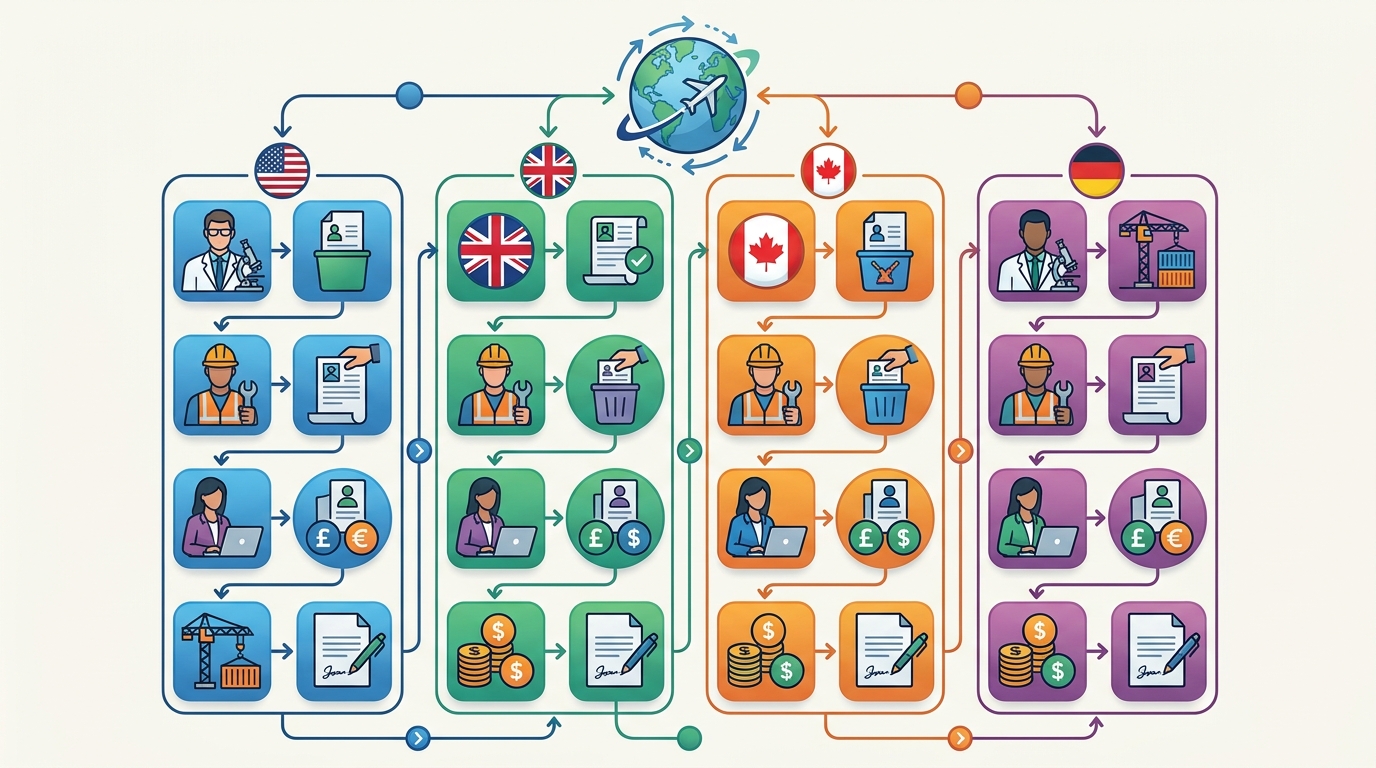
Skilled Worker Visa Updates: US, UK, Canada, Germany
Skilled worker routes in the US, UK, Canada and Germany all start from the same place: an employer willing and able to sponsor you, or a profile strong enough to be selected. The UK ties a job offer to a licensed sponsor and a minimum salary, the US tests whether a role is a specialty occupation, Canada scores you on a points grid, and Germany looks at recognised qualifications and a signed contract.
Marcus Lee · 9 min read
Average Salary by Role and Country: 2026 Benchmarks
There is no single "average salary" for a role that holds across countries, employers or even cities — earnings vary by experience, responsibility, performance, tenure and geographic area (U.S. Bureau of Labor Statistics, undated). The practical answer is to build your own benchmark from current, dated sources rather than quoting a number you saw once.
Ananya Rao · 8 min read
Remote Work in 2026: Companies Still Allowing It
Remote work has not disappeared, but it has narrowed. In March 2026, 22.6 percent of workers teleworked or worked at home for pay, and the rate has stayed between 21.5 and 23.0 percent over the last year (U.S. Bureau of Labor Statistics, 2026-04-16). The practical question now is which employer types still post fully remote roles, how those roles pay, and how to tell a real listing from a scam.
Wei Chen · 8 min read

How AI Is Changing Entry-Level Hiring in 2026
AI is changing entry-level hiring in two directions at once: it is absorbing the routine tasks that used to fill a first job, and it is pushing judgment, communication and tool fluency into the job description instead. Some employers are hiring fewer juniors because of it; others expect AI to help them hire more. The split varies by industry, employer size and state.
James O'Connor · 9 min read

2026 Layoff Tracker: Industries Hit Hardest This Year
Through September 2026, technology accounted for the largest block of announced U.S. job cuts among the industries tracked by Challenger, Gray & Christmas, at 165,925, ahead of transportation (44,430), health care and products (37,417), consumer products (30,652) and services (30,084) (OSPP Career Coaching, citing Challenger, Gray & Christmas, 2026). Artificial intelligence was cited in roughly 23% of all announced U.S. job cuts in the first half of 2026 (DEV Community, citing Challenger, Gray & Christmas, 2026). Announced cuts are not the same as jobs actually ended, and they say nothing about the employers still filling roles.
Nadia Hassan · 9 min read

Global Hiring Trends Report: Q1 2026 Update
Hiring in early 2026 is steady rather than booming. The number of job openings was little changed at 7.1 million in November (U.S. Bureau of Labor Statistics, 2026-01-07), while national hiring remains more than 20% below pre-pandemic levels of August 2019 (LinkedIn Economic Graph, September 2025). Growth is concentrated rather than general: more than 1.3 million new AI-related jobs have emerged globally over the past two years (Forbes, 2026-01-23).
Olu Adeyemi · 8 min read